
What Determines Gold Prices? A Complete Guide to the Factors That Move the Market
Gold has held its value across empires, currencies, and economic crises for thousands of years. Yet its price moves constantly — sometimes by hundreds of dollars an ounce in a single month. For anyone following the precious metals market, whether as a saver, an investor, or simply someone curious about the news, understanding why gold prices move is far more useful than just watching the number itself.
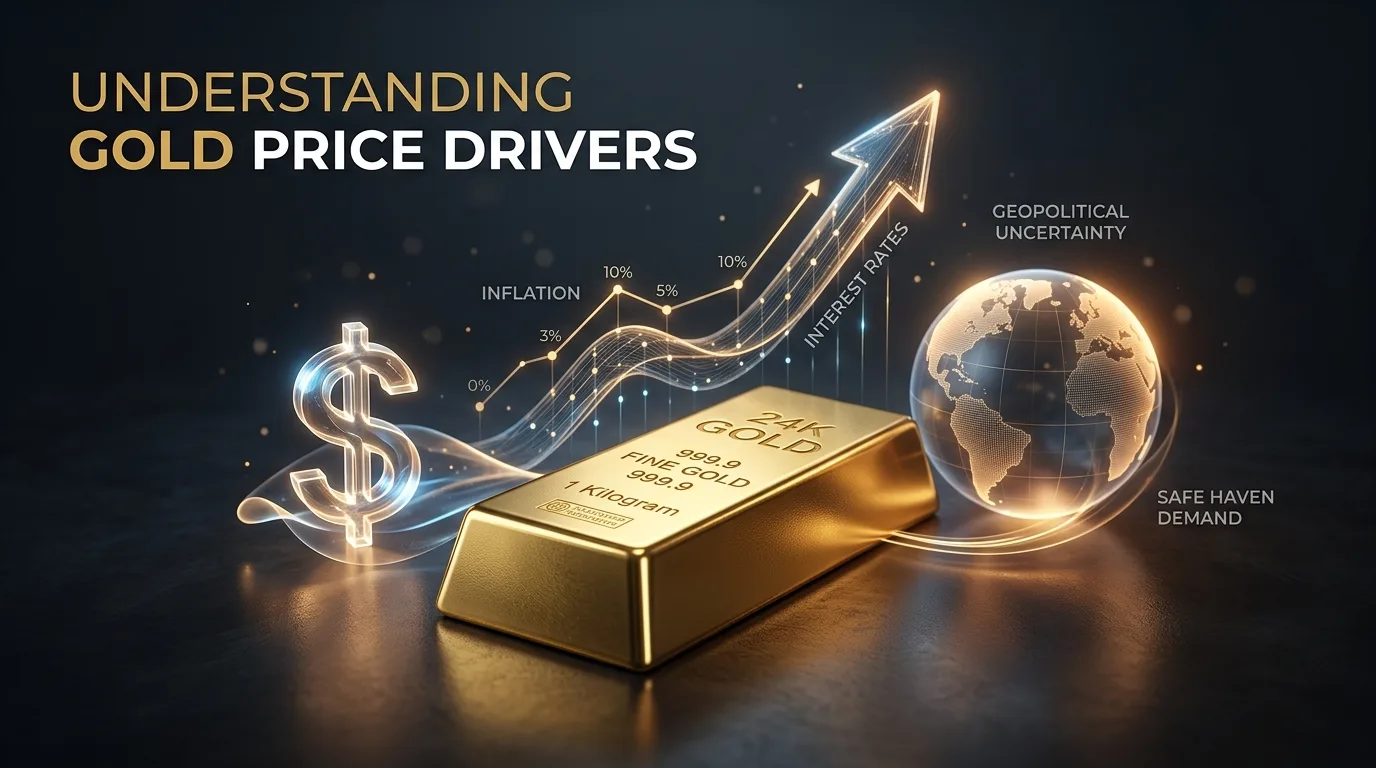
The gold price isn't set by one single factor. It's the result of several forces interacting at once: physical supply and demand, the strength of the US dollar, interest rates, inflation expectations, safe-haven demand, and central bank activity. Below, we break down each of these in plain language, so you can follow gold market news with more confidence.
1. Supply and Demand — The Foundation
Like any commodity, gold's price ultimately reflects the balance between how much is available and how much people want to buy. But gold's supply dynamics are unusual.
New mine production adds only a small percentage to the world's existing gold stockpile each year, because almost all the gold ever mined still exists in some form — in vaults, jewelry, electronics, and central bank reserves. This means gold behaves less like a commodity that gets "used up" and more like a financial asset whose total stock barely changes year to year. Mining output is also slow to respond to price changes, since opening a new mine can take a decade or more.
On the demand side, gold has several distinct buyer groups:
Jewelry demand, particularly from India and China, which together account for a large share of global consumption.
Investment demand, including physical bars and coins, and gold-backed exchange-traded funds (ETFs).
Central bank demand, as reserve managers buy or sell gold as part of national reserves.
Technology and industrial demand, a smaller but steady use in electronics and dentistry.
When investment or central bank buying surges, even a modest shift can move prices noticeably, because the "free float" of gold available for trading at any given time is relatively limited.
2. The US Dollar Connection
Gold is priced globally in US dollars, which creates a close — though not perfect — inverse relationship between the two. When the dollar weakens against other major currencies, gold becomes cheaper for buyers using euros, yen, rupees, or Egyptian pounds, which tends to boost demand and push the dollar price of gold higher. When the dollar strengthens, the opposite tends to happen.
A simple way to keep an eye on this relationship is to follow the US Dollar Index (DXY), which measures the dollar against a basket of major currencies. It won't explain every move in gold, but a strong divergence between the two is often worth a closer look.
3. Interest Rates and the "Opportunity Cost" of Holding Gold
Gold doesn't pay interest or dividends. If you hold a bar of gold, it sits there — it doesn't generate income the way a bond or a savings account does. This means that when interest rates rise, holding gold becomes relatively less attractive compared to interest-bearing assets, because investors give up more potential income by holding it.
What matters most isn't the headline interest rate on its own, but the real interest rate — the nominal rate minus inflation. When real rates are low or negative, the "cost" of holding non-yielding gold is also low, which historically has supported higher gold prices. When real rates rise sharply, gold can come under pressure even if nominal rates haven't moved much.
This is why gold traders pay close attention to central bank meetings, particularly the US Federal Reserve, and to bond market yields adjusted for inflation expectations.
4. Inflation and Inflation Expectations
Gold is often described as an "inflation hedge," and over very long periods, it has tended to preserve purchasing power better than holding cash. But the relationship is more nuanced over shorter time frames.
What tends to move gold prices isn't just current inflation data, but expectations about future inflation. If markets start pricing in higher inflation ahead — due to rising government spending, supply shocks, or loose monetary policy — gold can rally even before official inflation figures catch up. Conversely, if inflation expectations cool, gold can soften even while current inflation remains elevated.
5. Safe-Haven Demand During Uncertainty
Gold has a long history as a "safe haven" — an asset investors turn to when confidence in other assets, currencies, or the financial system is shaken. Periods of war, banking crises, sharp stock market declines, or sudden geopolitical shocks have repeatedly triggered surges in gold demand, as both institutions and individuals seek an asset perceived as carrying minimal counterparty risk.
This safe-haven behavior can temporarily override the other factors above. Even if interest rates or the dollar would normally point toward lower gold prices, a sudden geopolitical shock can send gold sharply higher as investors prioritize stability over yield.
6. Central Bank Reserves
Central banks are major holders of gold, using it as part of their official reserves alongside foreign currencies and government bonds. Over the past decade, many central banks — particularly in emerging economies — have been net buyers of gold, partly as a way to diversify their reserve holdings.
Because central bank purchases and sales involve very large quantities, sustained shifts in this buying pattern can have a meaningful structural effect on gold demand over time, separate from the day-to-day moves driven by traders and short-term investors.
7. Currency Considerations for Local Buyers
If you're buying or following gold prices outside the United States, there's an additional layer to consider: your local currency. The price of gold in your currency is effectively the international US-dollar gold price multiplied by the exchange rate between the dollar and your currency.
This means gold can rise in your local currency even on a day when the US-dollar gold price is flat — simply because your local currency weakened against the dollar. For buyers in the Middle East and North Africa, where some currencies are pegged to the dollar and others float freely, this distinction can meaningfully affect the price you actually pay.
How These Factors Work Together
In practice, these forces rarely act in isolation. Consider a scenario where a central bank signals it may cut interest rates while geopolitical tensions are rising: falling real rates reduce the opportunity cost of holding gold, while safe-haven demand adds an extra layer of buying interest — both factors pushing in the same direction. In other periods, factors can pull against each other, such as a strong dollar offsetting safe-haven buying, which is part of why gold's day-to-day moves can sometimes seem to defy a single simple explanation.
Frequently Asked Questions
Does the gold price change throughout the day? Yes. Gold trades nearly around the clock across major financial centers, so the price — known as the "spot price" — updates continuously during market hours, reflecting real-time supply, demand, and the factors discussed above.
Is gold always a good hedge against inflation? Over long periods, gold has generally preserved value well. Over shorter periods, its relationship with inflation is less consistent, since interest rates, the dollar, and investor sentiment can outweigh inflation's direct effect at any given time.
Why is the price I pay at a jewelry shop higher than the spot price? The spot price reflects the wholesale price of pure gold. Retail prices typically include a premium covering fabrication, purity differences, dealer margins, and local taxes — which is why retail prices for coins, bars, or jewelry differ from the spot price you see quoted in the news.
Final Thoughts
Gold prices reflect a constantly shifting balance between physical supply and demand, currency movements, interest rates, inflation expectations, and the broader appetite for safety in uncertain times. No single headline tells the whole story — but understanding these building blocks makes it much easier to interpret why gold is moving the way it is on any given day, and to put short-term price swings into a longer-term context.