
Copper Prices Explained: Why "Dr. Copper" Predicts the Economy
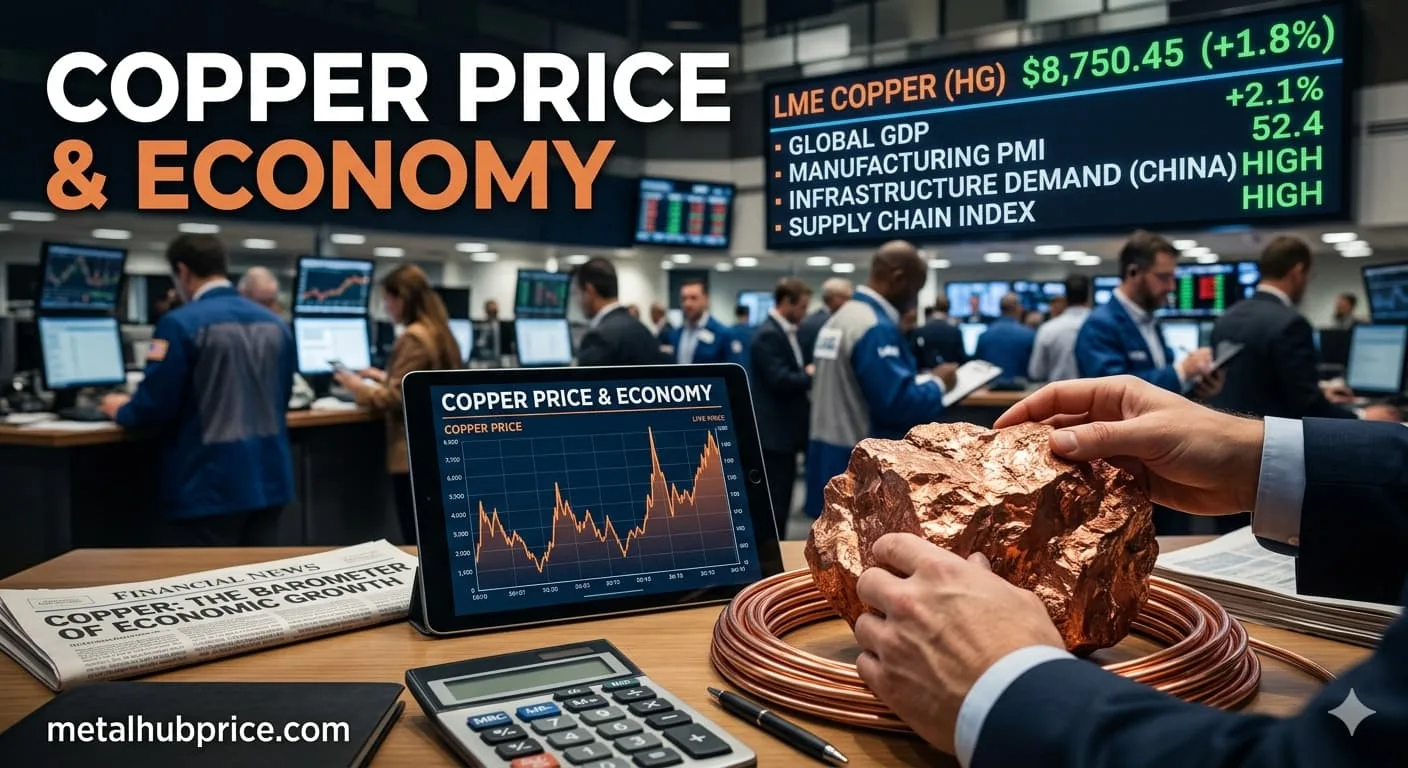
Among industrial metals, copper holds an unusual reputation. Traders and economists sometimes refer to it as "Dr. Copper," a nod to the idea that the metal's price movements can offer an informal diagnosis of the broader economy's health. Unlike gold, which is prized largely for its monetary and store-of-value role, copper's price is driven overwhelmingly by its use in construction, electronics, and infrastructure, making it a closely watched barometer of industrial activity.
This article explains why copper earned this nickname, what actually moves its price, and how it differs from precious metals in ways that matter for anyone following the metals market.
Why "Dr. Copper"?
The nickname reflects a simple observation: copper is used so broadly across the economy that sustained increases or decreases in its price often correlate with the direction of broader economic activity. Because copper goes into wiring, plumbing, electronics, vehicles, and construction, its demand tends to rise when factories are running, buildings are going up, and consumers are spending, and to soften when economic activity slows.
This doesn't mean copper prices perfectly predict recessions or expansions; like any single indicator, they can give misleading signals at times. But because copper demand is so closely tied to real-world industrial and construction activity, rather than primarily to investment flows, its price trends are often watched as one piece of evidence about the state of the global economy, alongside many other indicators.
What Copper Is Used For
Understanding copper's price requires understanding where the metal actually goes. Major uses include:
Construction: electrical wiring, plumbing, and roofing in residential and commercial buildings.
Electrical and electronics: copper's excellent conductivity makes it essential in motors, transformers, and a vast range of electronic devices.
Transportation: vehicles, particularly electric vehicles, which use substantially more copper than traditional combustion engine vehicles due to their wiring and battery systems.
Renewable energy infrastructure: solar panels, wind turbines, and the electrical grid upgrades needed to support them all use significant amounts of copper.
Industrial machinery and equipment: copper components appear throughout manufacturing and industrial equipment.
This breadth of use is precisely why copper demand tracks so closely with overall economic health: it's woven into nearly every sector of an industrializing or developed economy.
The Main Drivers of Copper Prices
Global industrial production and manufacturing activity. Since copper is a direct input into so much industrial activity, measures of manufacturing health, such as purchasing managers' indices, often move in tandem with copper demand expectations.
China's economic activity, in particular. China has been the world's largest copper consumer for years, driven by its scale of construction and manufacturing. As a result, data and policy signals related to the Chinese economy, particularly its construction and infrastructure sectors, tend to have an outsized effect on copper prices relative to many other commodities.
Construction and housing markets. Because copper is heavily used in both residential and commercial construction, housing starts, construction spending, and related data in major economies factor into copper demand expectations.
The energy transition. The growth of electric vehicles, renewable energy generation, and grid infrastructure has added a structural source of copper demand. Electric vehicles and renewable energy systems are significantly more copper-intensive than the technologies they're replacing, which some analysts view as a long-term demand driver distinct from the traditional industrial cycle.
Mine supply and production disruptions. Copper mining is concentrated in a relatively small number of countries, and production can be affected by labor strikes, regulatory changes, weather events, or aging mines producing lower yields over time. Because new mines take many years to develop, supply can be slow to respond to price signals.
The US dollar. Like other commodities priced internationally in US dollars, copper has an inverse relationship with dollar strength, similar to the dynamic described for gold, though copper's price is driven far more by industrial fundamentals than by dollar movements alone.
Inventory levels. Copper inventories held in major exchange-monitored warehouses are tracked closely by traders, as rising or falling stockpiles can signal shifts in the supply-demand balance before they show up clearly elsewhere.
How Copper Differs from Precious Metals
It's worth being explicit about how copper's price behavior contrasts with gold and silver:
Demand composition: copper demand is overwhelmingly industrial, while gold demand is overwhelmingly monetary and investment-related, with silver positioned in between.
Safe-haven behavior: copper generally does not benefit from "safe-haven" buying during financial uncertainty the way gold does; in fact, copper often falls during periods of acute economic stress, since such stress typically signals weaker industrial demand ahead.
Storage and physical market: industrial metals like copper are typically traded and stored in large industrial quantities through commercial supply chains, differing from the retail bullion market that exists for gold and silver coins and bars.
Price sensitivity to growth expectations: copper prices tend to be more directly and immediately sensitive to economic growth forecasts than gold, which can rise even during periods of economic weakness if safe-haven or monetary factors dominate.
Reading Copper Price Trends in Context
Because copper is so tied to industrial demand, sustained price trends are often discussed alongside other economic indicators rather than in isolation. A rising copper price during a period of strong global manufacturing data and infrastructure spending tells a fairly coherent story about demand. A rising copper price driven primarily by a supply disruption at a major mine, by contrast, reflects a different dynamic; one about constrained supply rather than necessarily strong demand.
This is why experienced market watchers tend to look at copper prices together with other data points, such as manufacturing indices, construction spending, and inventory levels, rather than relying on the price alone as a standalone signal.
Frequently Asked Questions
Is copper a good investment for portfolio diversification?
Copper behaves differently from precious metals and from many financial assets, since its price is driven primarily by industrial and economic factors rather than monetary or safe-haven demand. Some investors view this as offering diversification value, though copper also tends to be more directly correlated with overall economic cycles than gold or silver.
Why does the energy transition matter so much for copper demand?
Electric vehicles, solar installations, wind turbines, and grid upgrades all require substantially more copper per unit than the technologies and infrastructure they replace. As adoption of these technologies grows globally, many analysts view this as adding a structural layer of demand on top of copper's traditional industrial uses.
Does copper move in the same direction as gold?
Not necessarily, and at times they move in opposite directions. Gold often performs best during periods of economic uncertainty or financial stress, when investors seek safety, while copper tends to perform best during periods of strong, confident economic growth. Watching the relationship between the two can sometimes offer insight into whether markets are pricing in growth or caution.
Final Thoughts
Copper's nickname as "Dr. Copper" reflects a genuine pattern: because the metal is so deeply embedded in construction, manufacturing, electronics, and the growing energy transition, its price tends to move in response to real industrial and economic activity rather than primarily monetary or safe-haven factors. Understanding what drives copper, and how that differs from the forces shaping gold and silver, makes copper price movements far more informative, both as a standalone market to follow and as one input among many for thinking about the broader economic picture.